

Institutional investors and technology specialists in our Expert Voices network explain how efficient data management drives improved performance
Institutional investors and technology specialists in our Expert Voices network explain how efficient data management drives improved performance
Information asymmetry is a key factor in value creation in private markets. It’s what allows a GP to take a different view from their peers and shape a thesis to win the investment or acquisition race. For LPs, it helps them select the funds and managers that will outperform, which is particularly crucial in alternative assets, where the variance of returns across quartiles is considerably higher. While there’s debate about whether alternative assets outperform in aggregate, there’s little argument about the fact that top-quartile managers deliver higher returns.
Critics argue that private markets are opaque and secretive. This may be true in terms of access to information for the wider public, but between LPs and GPs too much information can be a challenge. Increasingly stringent regulations, big data at the investment level, and the adoption of non-financial metrics will only intensify the data management demands. For LPs, information management, comparability, accuracy, and timeliness are critical issues.
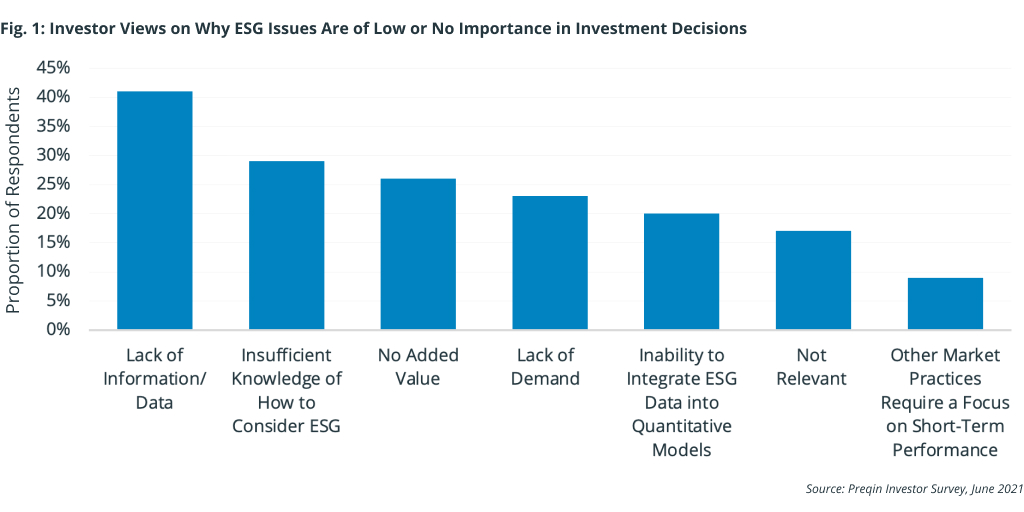
Reporting around environmental, social, and governance (ESG) issues is a good example of the difficulties investors can face. There’s now widespread and increasing acceptance among investors around the world that ESG factors should be an investment consideration. The biggest single reason why ESG was of little or no importance in investment decisions for respondents to a survey for Preqin’s H2 2021 Investor Update was a lack of information/data, cited by 41% (Fig. 1). Nearly a third (29%) cited a lack of knowledge, with 20% citing an inability to integrate ESG data into quantitative models. These proportions are high when compared with the 26% who saw no added value in considering ESG.
Information processing and flow in private markets are years behind public markets. But attempts to standardize and streamline processes – with the goal of giving LPs more timely, accurate, and comparable data – are beginning to gain traction. We asked two LPs and an expert from Colmore, part of the Preqin family, how they’re tackling these thorny problems.
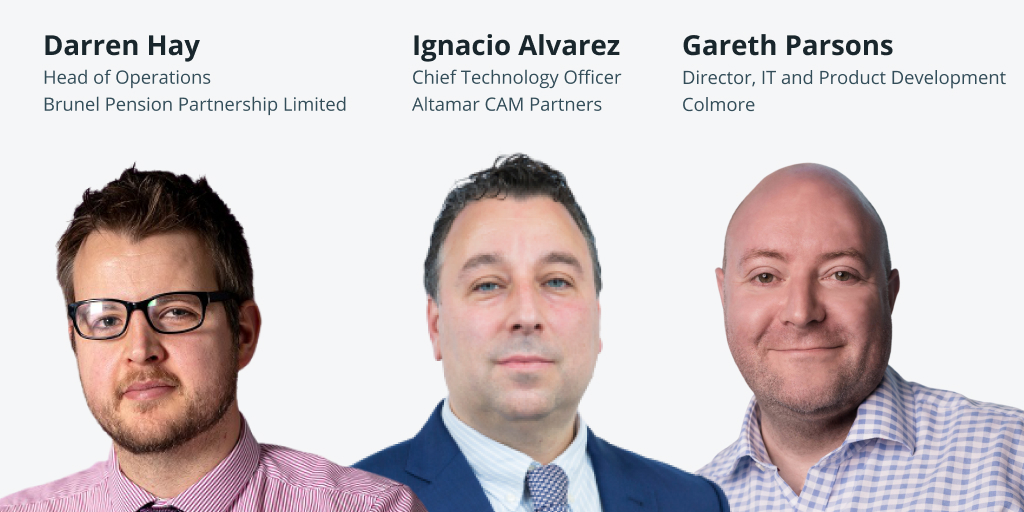
Ignacio Alvarez, Chief Technology Officer at Altamar CAM Partners:
A few years ago, data collection and processing was an entirely manual process, but that’s changing. Now we use a range of technologies, including robotic scraping, natural language processing, and artificial intelligence (AI) to get and map information. The type and complexity vary from a simple invoice for a capital call to a complex quarterly or annual report with all the underlying valuation methodology, different KPIs, and so on. There have been attempts to standardize information in private markets in the past, but they have mostly failed. There have been advances recently, such as ELISE and the ILPA guidelines, and there are moves toward basic standards.
The main problem is that we’re in a market that gives a lot of information, but it’s all concentrated at the end of the quarter. Even with a huge team – which wouldn’t be practical or economic – you wouldn’t be able to manage it.
So, we’ve taken a hybrid approach. We’ve outsourced some functions to Colmore, which brings cost efficiencies and helps reduce the stress on our team during the busy periods. And we’re investing heavily in technology solutions, including robotics, AI, and blockchain, for data gathering, processing, and things like smart contracts. But we still have to maintain an element of manual processing because there’s often not the technology on the other side, particularly at smaller and emerging GPs.
_________________________________________________________________________________________________
Darren Hay, Head of Operations at Brunel Pension Partnership Limited:
In listed markets we've been able to outsource our whole middle- and back-office investment operations. It’s only in the last few years that private market administration has taken off, but quite a lot of middle-office activity – treasury, cash management, legal, corporate – still has to be handled in-house.
In private markets we spend more time making sure the right data is coming in and we’re seeing the right things. For example, valuations come from the GP. GPs remain responsible for producing them, but we have to know the assumptions, and why they might be cautious or adventurous. We need to get into the weeds and understand the fund and the way the managers work. The other thing is keeping up to date. In private markets we get data months late, compared to listed markets where it’s almost intraday. They’re chalk and cheese.
We’ve been able to outsource the data processing elements to Colmore. They’re the frontline with the GPs, taking in and processing statements, some elements of cash management, and overlay services like fee monitoring. Colmore were far and away the most flexible administrator and we were able to mold their offering to suit our needs. They’re a new business and there have been some growing pains, but we’ve worked hard to address them. Outsourcing the manual and heavy-duty administration allows us to keep a lean team focused on manager selection, portfolio construction, and composition, and making sure the portfolio performs the best it can.
_________________________________________________________________________________________________
Gareth Parsons, Director, IT and Product Development at Colmore:
The increase in data has been huge. I can’t think of a better word. Where we were tracking three operational KPIs on an asset, now we’re actively tracking 35. KPIs are an evolving part of the private assets market and will continue to grow – we’ve built out a model for around 200 KPI data points. This now also includes ESG, which is one of the biggest requests we’re seeing.
The only way we can keep pace with the ever-expanding requirements of clients is to scale the way we think about managing, processing, extracting, and validating data. While there are many single technology solutions LPs can use to meet their different requirements, we take an end-to-end service and technology approach. We want to automate an LP’s entire private markets data lifecycle, from capture to reporting, always with quality data. And so we’ve invested a ton in building machine-assisted solutions, while maintaining a quality process across the data lifecycle, from document capture to data extraction and validation. Our people are our validation engine, a human-in-the-loop process on the machine’s extraction, and are central to quality control.
The solutions we build are deeply rooted in our background. As a former LP and a GP, we really understand the issues and problems on both sides. We can only hope that our experience as an investor will continue to shape our forward-thinking product roadmap, so we can be in step with our clients and their ever-evolving requirements.