

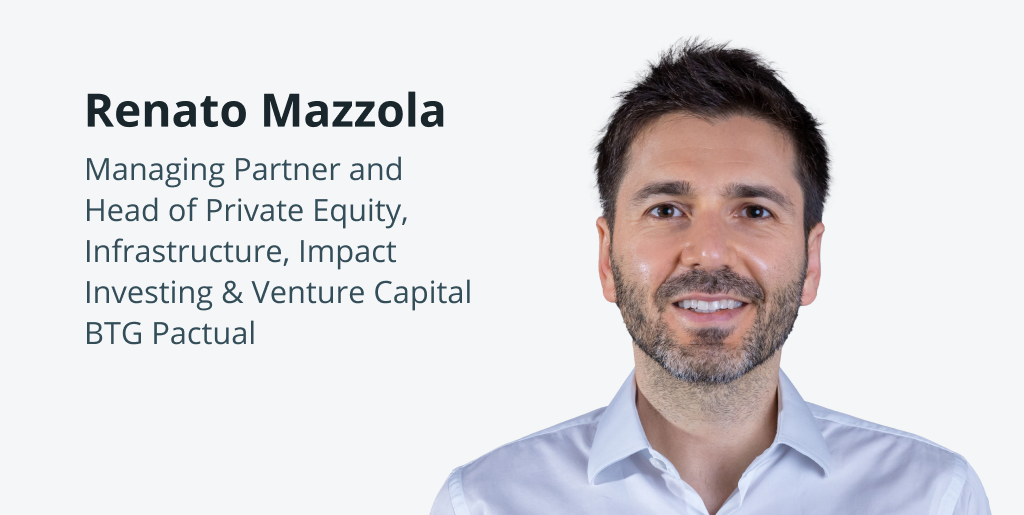
BTG Pactual’s Renato Mazzola discusses how his company manages the risk and opportunity in Latin America
How are private capital managers navigating the economic volatility in Latin America?
As an emerging nation, Latin America’s economic volatility has played and will play a large role in Brazil’s market dynamics, both past and future. And in this environment, we have encountered fewer managers in the region that have been able to build and manage a portfolio which tactically allows it to be less impacted by ever-changing macroeconomic scenarios.
Since I began working in the financial market in 1997, I have witnessed multiple crises, including sociopolitical events, volatility in FX, and interest rates. Asian tigers in 1997, Russian crisis in 1998 and specifically in Latin America, we faced the devaluation of the Brazilian real in 1999, the Dilma political crisis in 2013, protests and social rises in Chile in 2019, and COVID-19 in 2020, among others. Even when facing those various economic cycles, our private capital investments, including private equity, infrastructure, and venture capital, have outperformed their target returns. More importantly, the interest of re-ups by our investors is increasing (approximately 53% of our 2021 vintage investors came from previous funds), which is our most important metric of success.
Unfortunately, historically there were emerging managers in the region which were not able to return capital to their investors and this left many of them dissatisfied. One of the motives for that is that these managers used to operate assets with long duration and high amounts of debt. Opposed to what many may imagine when investing in Latin America, I believe that the most sensitive factor is not FX, but rather interest rates. Brazil’s base interest rate went from 14% in 2016 to 2% in 2020, and now is at 13.25% in 2022- a big change in a short period of time. This was the reason many managers in the region faced difficulties managing companies with high amounts of debt - they were less prepared to navigate the volatility in interest rates. Therefore, those managers saw less interest from international investors.
Concerning foreign exchange-rate risk in Latin America, one must keep in mind that historically, FX rates tend to fluctuate between depreciation and appreciation over a 24-month period and shouldn’t be the main concern for longterm international investors.
Although Latin America has seen its fair share of recent economic and political events, we continue to see opportunities for investments, with geopolitics being comparatively less of a concern.
How do you build your portfolio and diversify your risk as an emerging market manager?
Looking at our own investments and experience as investment managers, we have been able to generate a strong track record of overperforming during several economic cycles and types of economic volatility, including high levels of inflation. We manage the assets with low debt exposure, so we have faced less volatility and even captured gains due to the movement of the interest rates. As mentioned earlier, I see interest rates as one of the largest risks of investing in LatAm, so we always make sure that our companies are not over-leveraged (maximum of 2x Net Debt/EBITDA), therefore having less impact in a climate like today’s. Also, we aim to invest in assets which have predictable revenues and are independent of economic cycle – our targets almost have a “contracted” revenue, thus suffering way less market risk. They are positioned in essential sectors, which are less impacted by volatility in the macro scenario, such as elections or shifts in interest rates. This strategy is part of our DNA.
We build our portfolios focused on managing a limited number of assets, so we usually have four or five companies in our funds. We believe that in this way, the team can focus more of their attention on fewer assets. It is easier to manage three funds with four assets in each, than one fund with twelve assets where the team might focus more on the better performing assets and less on the underperforming ones. As such, with a portfolio with fewer assets, we believe diversification is key to generate positive risk-adjusted returns. We diversify per industry, sectors, and economic cycles by disbursing between 25% and 33% of the committed capital per year. And when it comes to the FX risk, for better protection we look to invest in companies with revenues adjusted by inflation, which historically have a better performance against the FX volatility and revenues in US dollar terms.
We also build our portfolio around majority stakes in our portfolio companies. This gives us strong governance. Through active board participation, the team can make changes and truly be a value-add investor, so we usually end up allocating some of our team members directly in the investee.
Interestingly, when it comes to our investing philosophy, we have seen many of our LPs and developed-market peers look for insight from our long-standing local experience, edging them closer to investing in the region. We continuously work to change the negative image from the region and believe there are some strong managers that are returning capital for investors despite the economic volatility.
What sectors are appealing and will remain so with less volatility?
We look to invest in sectors and companies which are both resilient and often protected from market volatility. Typically, these companies have predictable revenues, low leverage, and are positioned in sectors which have encountered less volatility overall, such as energy, ports, telecommunications, education, and healthcare. Education has been a notably resilient sector, especially K-12, where unsatisfactory quality of the public education system has created a high demand for private solutions. The long cycle of students generates stable and predictable cash flows, as we saw in one of our portfolio companies, Inspira.
On the other hand, we believe that commodities and the retail sector, among others, will experience much more volatility in the region without a resilient demand, and more seasonality, therefore we prefer to invest in businesses less impacted by different macro scenario.
About
Renato Mazzola joined BTG Pactual in June 2011 and has more than 20 years of experience in the investment industry. He spent five years as Senior Investment Officer at the Inter-American Development Bank (IDB) and five years at JP Morgan. Renato holds a BA in Economics, an MBA in Capital Markets, and a Master’s in International Relations. He is a member of ANBIMA and Vice Chairman of Fundacao Estudar.