

Chatbots are moving from a parlor trick to virtual employees, but can they truly replace the human element?
Chatbots are moving from a parlor trick to virtual employees, but can they truly replace the human element?
Chatbot technology is quickly ascending into the mainstream as more industries leverage its capabilities. A quick web search returns several instances of how it’s being used across the spectrum of consumer services. Some of the experiences are positive, and others less so.
Chatbots are computer programs that use artificial intelligence (AI) and natural language processing (NLP) to mirror human interaction. The models are trained on inputs drawn from emails, social media interactions, customer service transcriptions, and other source training data, with the goal of creating a genuine-feeling human experience.
In more primitive times, this technology was mostly employed in customer service chat boxes on websites, later evolving into Apple’s Siri, Amazon’s Alexa, and Google Assistant. These were helpful to a point, assisting users with simple queries – similar to what they could expect from typing into a search engine. For more on the technology, IBM has created a comprehensive review of chatbots and their history, as well as pros and cons of the technology as it stands.
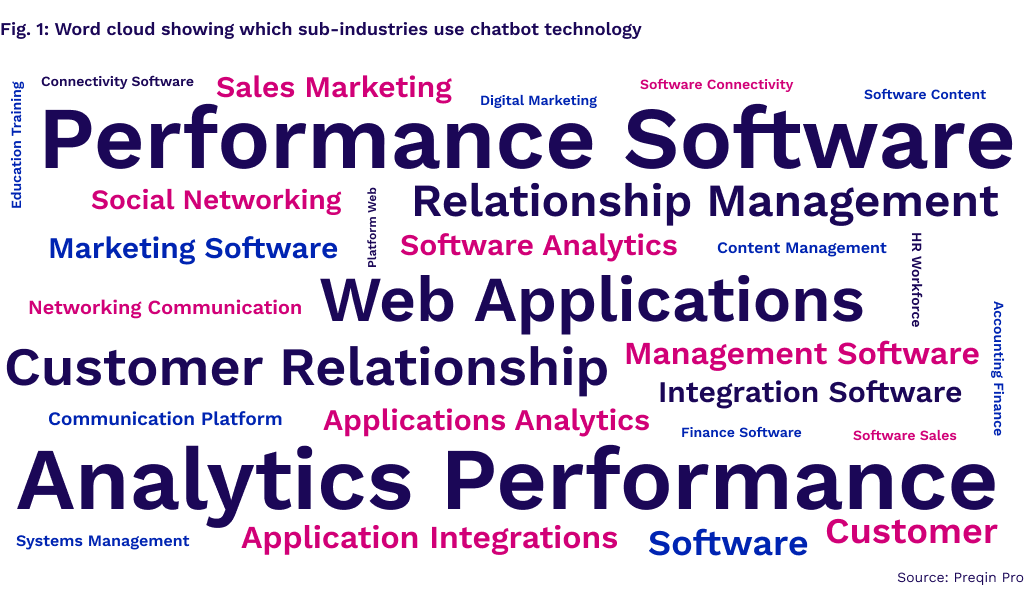
However, as machine learning and its AI and deep learning (DL) forms increasingly focus on chatbots, the technology has broken out of the smart speaker and into other industries and markets. A look at the sub-industries using chatbot technology shows activity in generalist areas like software performance and analytics. Yet there are more specific industry classifications, including healthcare, customer relationship management, and human resource management (Fig. 1).
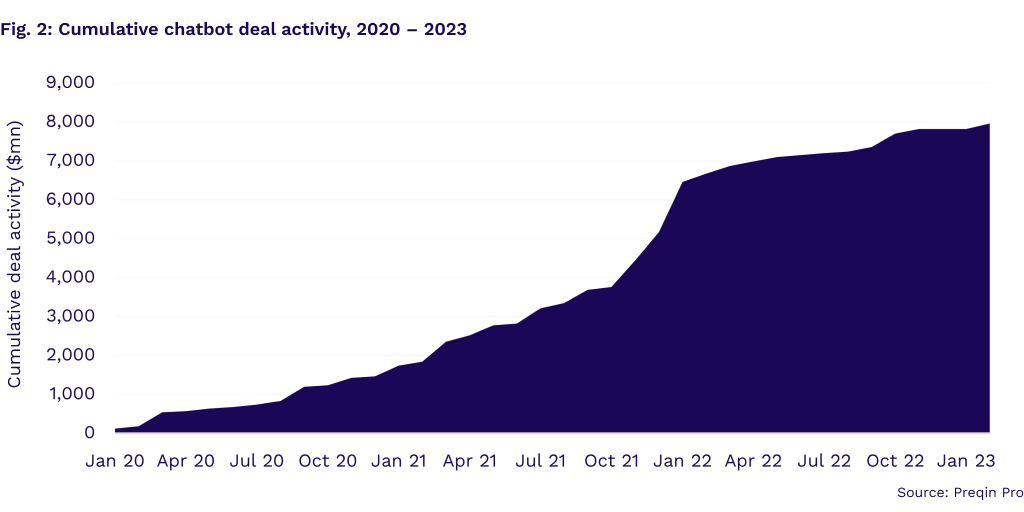
Since the start of 2021, VC firms have poured more than $6.5bn into chatbot technology (Fig. 2), and it’s received more than $13bn in VC funding since 2015. With this funding, companies have taken the technology beyond the chat window, unlocking the power of the underlying technology to read and anticipate human needs. This has made it possible to more specifically target advertisements, train employees, and manage customer service more accurately, among many other applications.
Who’s leading in chatbot tech?
Here we explore a few of the most significant companies by capital raised.
1. $635mn. Uniphore Technologies has raised $635mn over 10 deals since it was founded in 2008. The latest and largest deal was a $364.6mn series E round led by Sorenson Capital and March Capital Partners in January 2022. It was the fourth deal March Capital has been involved in with the company, and Sorenson’s second. Previous investors have included Chiratae Ventures, Iron Pillar, and Cisco Systems.
Uniphore’s platform uses speech and facial recognition software to automate customer service functions for B2B tech support, banking, healthcare, and telecommunications customers. Its technology also collects data from video interactions to measure a speaker’s emotions, tone of voice, and facial expressions.
In a 2017 blog, the company highlighted the impact of chatbots on the customer service experience. It explores how a chatbot can identify a customer’s needs, particularly at the point of first contact, allowing human reps to focus their time on more valuable and specific client issues.
2. $519.4mn. San Mateo-based Freshworks Inc. has raised $519.4mn since it was founded in 2010. Its key investors include VC investing veterans Sequoia Capital, Accel, and Tiger Global Management. Following a partial IPO exit in 2021, the company trades under the symbol FRSH. The IPO raised another $1bn for the firm, and Sequoia invested an additional $94.8mn in a PIPE transaction in March 2022. More recently, Sequoia partner, Westbridge Capital Partners completed two PIPE deals, one in January of this year and the other in February, however, details have not been released by the India-based PE shop.
Freshworks software focuses on customer support, communication, and relationship management, among other services. With more than 17,000 subscription-based customers, the company hopes to rival Salesforce.
3. $455.7bn. BloomReach, Inc. has raised $455.7bn across six rounds of VC funding and one venture debt round. The venture debt was provided by J.P. Morgan in October 2022, while its equity partners include Bain, Lightspeed Ventures, and Goldman Sachs. BloomReach software helps online-based businesses manage their marketing efforts, targeting customers through email, web, and mobile exposures.
While the success of VC start-ups in chatbot technology may have opened Pandora’s box, it hasn’t shut out tech behemoths like Microsoft and Google. Both are currently working toward using this technology to change the way people use their search engines. Most recently, Microsoft successfully demoed its version, which allows users to converse with its Bing search engine rather than simply type in a word or phrase. Much of Microsoft’s success is thanks to OpenAI's ChatGPT model. The free service (which has a paid option, of course), allows users to ask the model to answer queries in stark detail (e.g., using Python code to create Fig. 1) or produce virtually any degree of content.
Yet the content produced by chatbots isn’t always perfect. AI models are only as good as the data used to train them and they are open to manipulation. Could competing companies train an open-source model with false information on a competitor? Of course. As the models evolve, logic and sanity checks need to be in place. For this article, I asked ChatGPT how each of the highlighted companies above use chatbots. While I could have copied and pasted this conversation with a machine, the response would still have needed to be verified from the source.
Power your deal-making with accurate and comprehensive private market data and intelligence on investor-backed companies. Get a complete view of the private capital lifecycle with interconnected company, fund, and performance data. Find out more about Company Intelligence today.
The opinions and facts included within the above do not constitute investment advice. Professional advice should be sought before making any investment or other decisions. Preqin providing the information in this content accepts no liability for any decisions taken in relation to the above.